Notes On Epic: what I’ve been working on in my Epic Traditions elective (#4, Final Portfolio)
“Epic knocks on your door at egregious hours, uninvited, and lets itself in.”
FINAL ESSAY: PART 1
Prologue
“We have in every Art more Rules than Examples, for Men are more fond of teaching, than able to perform”
Voltaire’s An Essay on Epic Poetry, 1727
“An epic is defined by what it intends to and ends up doing to its audience, not by what it contains or necessarily how it contains it…The word ‘epic’ dates back to ancient Greek noun ἔπος, meaning ‘word’ or ‘story.’ The general conception (or might I say mis-conception) I previously held surrounding epics was as follows: they must be immense tales (both in size and grandeur) detailing the arduous toils / perilous journeys of some glorious, charming, handsome, epitome-of-mankind hero (or immortal)—and they are written in some poetic meter, and performed in some oral way” (Jenna, Response 1). Homer’s Iliad and Odyssey sit comfortably at the apex of that conception, “crowned…as THE divine epic ‘texts’” (Jenna, Response 1), the golden children against which everything else is measured. Meanwhile, the term “epic” itself has wandered far from its home(-r): today it references quixotic blockbusters, three-day triathlons, and YouTube compilations of “epic fails.” Come along with me as I make a valiant attempt to find its meaning, for me, in “Final Essay: Part 1.”
PSA
For clarity purposes, here is me signposting how this essay will flow:
- Prologue (what you just read)
- PSA (what you are reading / about to read)
- Three revelations on “epic”
- My branch so far
- My final branch
- Epilogue
Ordering in short: first, what changed in my thinking this term (the three revelations); then, where I started (my branch/responses so far); then, where I have landed (my final branch/response).
An image I reference throughout this essay: think of the question “what is epic?” as a tree. I argue that the trunk of the tree is the one thing every answer to “what is epic?” must share: it “moves” us. Each branch is an individual’s unique definition of epic, shaped by who they are and what they carry. This tree holds room for 8.3 billion branches, one for each of us.
Three Revelations
This response will document three of my recent revelations on what epic is.
1. CONFESSION
Over the past few weeks, I fell into the trap Voltaire warned about: I built rules… invocation, metapoetry, “grand-ness,” dialogue with tradition, chosen ties. With each response piling on boxes, I forgot that all of it was only ever meant to be an example of one rubric. Yes, Voltaire, I plead guilty; we do have “more Rules than Examples.”
Italo Calvino in one essay alone offers 14 definitions of a classic, and almost none of them describe what a classic should contain. They describe what it does to the people holding it: “The classics are books that exert a peculiar influence, both when they refuse to be eradicated from the mind and when they conceal themselves in the folds of memory, camouflaging themselves as the collective or individual unconscious” (Calvino, definition 3). A classic is a book we read differently at twenty than at twelve, not because the pages changed, but because “we have most certainly changed” (Calvino, page 2). It is the book “you cannot feel indifferent to” (Calvino, definition 11). My first response said the same of epic: it is about what a work does to its audience. I regrettably spent the next two writing rules for the work itself and none for the audience, even though the audience was me.
2. HUMANS DECIDE WHAT IS EPIC
For our midterm projects, each of us chose an epic to argue for or against, and as Abi pointed out, each of us chose something personal. I examine this order: we chose first, because a work had already moved us, and found the epic inside it second. We made those works epic.
So, this revelation, perhaps a mundane one, but still my own: the human makes the epic. Each person who explores what epic means to them flowers a new branch, and this response is just one of the 8.3 billion. Only I could have produced this specific one, and it represents only my branch of what epic is…to me. I want it to be as expansive as possible (approachable to all, because that is also, quite frankly, epic) while still being a “rubric” only I could write.
But I also want this to be a path others can walk along to find their own branch, so along the way I will ask questions that helped me grow mine. They are labeled in all capital-letters. Everyone’s branch looks different, like fingerprints.
3. EPIC CANNOT EXIST WITHOUT HUMANS
Without us, there is no epic. If the ultimate goal of epic is to “move,” then it has to move someone. A work cannot move an empty room; it needs a human, carrying their own emotions and baggage before it can cross over into “epic” territory. My previous responses all overlooked the person standing in the middle of all of it: in this case, me (not to be egocentric). Every epic revolves around a human who perceives it (or many humans, but even then, each human still has a separate experience). And that human, carrying their human experiences and human features, is the single most important part of the whole process.
At its core, epic lives in people, is created by people, and exists for people. Homeric epic was “not texts and certainly not… fixed texts” (Jenna, Response 1): the Iliad is not inherently an epic on its own. Even the ancients agreed that a human must be involved. Hesiod’s Muses are as divine as sources get. If any being could make “epic” epic on its own, it would be them. Yet they still breathe a “voice [audē]” (Hesiod, Theogony, 32) into a human body. Divine inspiration still requires a mortal. The Muses, daughters of Mnemosyne (Memory), perpetuate kleos, which lives only in people who remember. Even ἔπος, “word,” needs someone to hear it for it to mean anything.
An epic is not a fixed work to be observed but an event (yes, a temporally-speaking event), an encounter: the moment when “epic” and human overlap. What that person enters the encounter with meets what the “epic” offers in that encounter, and both leave changed: the human is “moved,” and the “epic” gains another human layer. Hence the quotation marks: I don’t believe a work is born epic. At its inception, it can only stand as a candidate. Only when it(s themes) meet a human, and resonate in harmony or dissonance, can we judge whether the work transcends into “epic” territory.
My Branch So Far
A trip down memory lane, since the only right way to end is to start where I started.
Response 1: epic is solely defined by what it does to its audience: if it “mov’d… [and] satisfy’d” (Voltaire) us. Greek epic, I said, has its own signature features: an invocation to the Muse(s), metapoetry, and some “grand” figure, though not necessarily a grand deed. Response 2: “Roman epic keeps the purpose (moving its audience)...but by appropriating and experimenting with Greek epic traditions it expands that purpose to provoking thought,” while staying in “conscious dialogue with tradition and with the poet’s own time.” Response 3: “modern epic is tied to prior epics by its gestures…and it becomes its own by reclaiming the ties that were once forced,” finding “grandeur in the many and in what goes unsaid.” Each response grew from the same trunk. Response 4 (this one): I attempt to step back and look at the whole tree plus my branch.
If there is any one uniform definition of epic, I can only look back to Voltaire: it “moves” people. Everything else grows from this trunk. And to “move” does not just mean tears: laughter, shock, disgust, awe, all of the above count. Epic should be judged, if anything, by the intensity of the feeling, not its flavor.
To exemplify, Demodokos, the blind bard of the Phaeacian court in book 8 of Homer’s Odyssey. In a single book he sings of the gods’ arguably most embarrassing affair (Ares and Aphrodite caught naked in Hephaestus’ golden net) and a tale of the Trojan War, and Odysseus weeps. The dynamic in one evening is vastly polar. While Odysseus weeps, the Phaeacians surrounding him are fine: “the greatest of the / Phaiakians would urge [Demodokos] to sing, since they joyed in his stories, / Odysseus would cover his head again, and make lamentation” (Lattimore, The Odyssey of Homer, 8.90-92). Perhaps the latter song simply wasn’t as epic to some of them: one “epic” does not have to resonate with all in the room. Back in Response 1, I gave both songs the same verdict: “whether we laugh at gods caught cheating or weep at the fall of Troy, the verdict is all the same: epic” (Jenna, Response 1).
WHAT WAS THE LAST THING THAT KNOCKED YOU OUT OF A “NEUTRAL” STATE? WHAT MADE YOU FEEL FULLY, INDISPUTABLY HUMAN?
Different branches also grow depending on where and when you look, but they still stem from the same trunk. In ancient Greece? Fine, then expect an invocation to the Muses of some sort (and even that isn’t strictly required). But a Slovenian or Chinese epic need not invoke the “Muses of Helikon, who abide on the great and holy Mount Helikon…with dainty feet [and] dance… around the altar of the mighty son of Kronos” (Hesiod, Theogony, 1-5) to count. Surely one cannot “fail” a work for missing a gesture its creator’s tradition never had.
Even within the Western tradition, said gestures metamorphosize. Lucretius, an Epicurean who denied the gods meddled in human affairs, still opened De rerum natura with an invocation, to Venus, mother of Aeneas and so of the Romans too, instead of the Muses. Robin Coste Lewis titles a section of “The Voyage of the Sable Venus” “Invocation,” to no traditional Muse; it opens with “Untitled / Anonymous / Clay.” Neither of these fail as epics. In these, the gestures survive because of the traditions bending.
Apply the right “lens.” Like camera lenses, each is built for a different kind of shot; choose the one that fits the work before you evaluate. Note that it is permissible to say a work can be considered an epic, but that simultaneously you as an individual do not consider it an epic.
WHAT TRADITION DOES THIS WORK IN FRONT OF ME COME FROM? WHAT WOULD ITS OWN AUDIENCE HAVE EXPECTED AN EPIC TO LOOK LIKE? AM I JUDGING IT BY ITS RULES OR BY MINE (WHAT LENS AM I APPLYING, AND ARE THEY FAIR)?
My Final Branch
Now, my own branch. Everything above was general; everything below is an EXAMPLE of what one person, me, requires for an “epic” to be epic, beyond the shared trunk of being “moving.” It is my final response, for now, and this branch is still a work in progress. This section divides into two groups: my requirements for the “epic” itself, and the encounter.
MY REQUIREMENTS FOR THE WORK ITSELF
1. A gesture to its own tradition, based on creator intent.
Now you may ask, what if the work we are evaluating is trying to establish a new kind of gesture? An “epic” should make a gesture to its own tradition’s epic motifs, based on creator intent. If the creator is working and intends to perpetuate inside an established tradition, one should be able to recognize that tradition’s gestures somewhere in the “epic.” If the author intends to start a new epic tradition, then they get to create the gestures. Which is exactly my argument on why this cannot be a rigid checklist: the boxes are constantly changing depending on who is building and what they intend to build. And we will never know what some of them intended to do. We cannot, as a wise man once said, “speed-dial Homer” (your words, Doc V, not mine).
What we can do is look at what they built. Virgil, for one, performed some surgical reconstructions of Homer: the first half of the Aeneid is his Odyssey (a hero wandering the sea, trying to reach home, a nostos), and the second half his Iliad (a war). Surgical, like I said before: Homer’s skeleton with a transplanted Roman heart, working both inside a tradition and founding a new one in 12 books.
2. It engages with the world it was created in
Whether that world is fantastical or not does not matter, as long as the time and place it was made in still show through.
WHAT WAS HAPPENING IN OUR WORLD WHEN THE WORLD OF THE “EPIC” WAS MADE, AND CAN YOU HEAR OUR WORLD’S “NOISE” (Calvino) STILL BREATHING BENEATH ITS STORY?
3. It carries universal themes, with room for the personal
Love, home, death, time (there are too many to count): themes wide enough that anyone could connect with them, but open enough that each person can connect in a unique way.
WHAT THE ENCOUNTER BETWEEN WORK AND HUMAN REQUIRES
Note: you may feel the next four leaning and bleeding into each other. This is fine, because they all describe one thing: what should happen when the human and epic meet.
4. The epic overlaps with what I arrive with
I walk in carrying my humanity: a memory, mood, thought. The “epic” may or may not meet it. The epic will.
WHAT WERE YOU CARRYING WHEN YOU ENCOUNTERED THE “EPIC”? WOULD IT HAVE “HIT” THE SAME WAY A YEAR EARLIER?
5. I add to it
The “epic” is not “epic” before I arrive. I add to it. I bring the humanistic aspect and resonation that the work did not possess (and could not have possessed) prior to me, so I become one of its builders. Coste Lewis does exactly this in “Voyage of the Sable Venus,” which is built entirely out of other people’s words: titles and catalogue entries of Western artworks featuring Black women, copied without a single change. The titles already existed—not epic on their own. Coste Lewis added herself into the picture, and that is what turned museum catalogues into an epic.
WHAT DID YOU BRING TO THE “EPIC” THAT NO ONE ELSE COULD HAVE?
6. I leave differently from how I entered (whether I lost or gained)
Our encounter changes me, for better or for worse.
ARE YOU THE SAME PERSON (not genetically or scientifically, though an argument can be made that your neurons change structures…) YOU WERE BEFORE YOU MET THIS WORK?
7. It stays, and keeps working in my mind after it “ends.”
I wrote this specific requirement to pre-emptively answer questions like: by your logic, isn’t a funny TikTok reel you laugh at hysterically also an epic? No. Maybe it moved me (and that’s me being generous, because I’m not sure some snorts and curled lips qualify as “moving” yet), briefly, at 7:45 A.M. But by 7:46 A.M., it was more than certainly gone. Epic knocks on your door at egregious hours, uninvited, and lets itself in.
DO YOU FIND YOURSELF ACTIVELY THINKING ABOUT IT? DOES IT RETURN UNINVITED?
I recognize the above may read like a list of criteria again, which is ironic since I just confessed to being trapped by exactly that. But to reiterate (for my sake, mainly): these are just personal observations, a documentation of a path I walked.
Epilogue
After a term grappling with what epic is, one question remains: why does any of this matter? I will preface by saying I felt heavily inspired by Kae Tempest to write this segment.
Keep a fixated lens on the past, glorifying Homer and Virgil until the cows come home, and we may never (in our lifetimes) recognize the epics of our own day, the ones future generations will hold up the way we hold up the Iliad. A static rubric is limited to recognizing only works that look identical to the ones it, itself, was built from. What glory lies in the same epic, copied over and over? If every copy “met” every reader in exactly the same way (over and over again), no one could bring anything new to it, and without that, would it not slip back into “epic,” in quotation marks? Methinks so. We are, as Telemachus avidly observes (truly one of his, like, top two most epic moments), always searching for the newest song.
Kae Tempest. The epics of our day are already being built, right now, by people nobody would think to call poets: a pre-schooler practicing how to spell, a teenager discovering the paintbrush, an ordinary woman walking down the street, carrying a life no one else can see. Each of us is actively building the next “epic.” Each of us is epic.
“You were born for greatness.
Believe it,
know it –
…
we’re the same beings that began,
still living,
…
The stories are you
…
the Gods are all here.
Because the Gods are in us.”Tempest, Brand New Ancients
A meta-reflection to wrap-up: this writing process was not static (which feels fitting). I began, set on arguing that epics need humans to “make” them: a singer, a listener, someone to remember and perpetuate the kleos. I have arrived elsewhere; bear with me as I try to formulate this thought. If we are the ones who turn “epic” into epic, then epic was never only in the work. Every “epic” becomes epic only when a human makes it so. That power to create epic lives in us, which means epic (no quotations) does too. With great power comes great responsibility.
Thank you, Doc V, sincerely. This response is as much yours as it is mine.
CRITIQUE ESSAY: PART 2
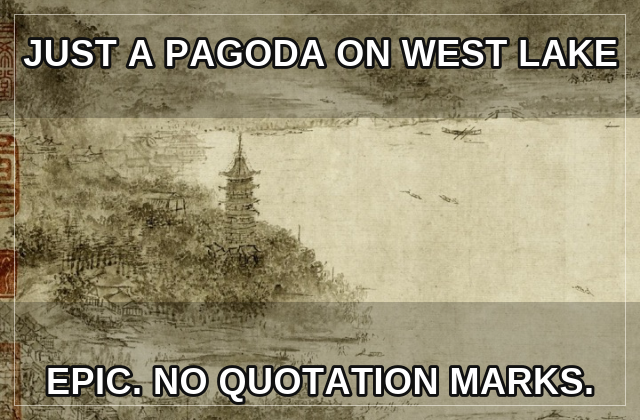
Summer in Hangzhou, sometime before I can spell “Hangzhou.” The heat is draping over the city like a damp towel (how I love climate change). The air at my height smells of hot stones and sunscreen. I stand at the foot of Leifeng Peak, head craned and tipped back enough that the pagoda I meet fills my whole sky: eight-faced, storey stacked on storey, eaves curling up at the corners as if the roof will lift the pagoda off the ground and float away. I have never seen anything so “epic.”
Beside me, tourists raise their phones, pout their lips (or do whatever millennial poses are popular at the time—it’s circa 2013 I think, if that helps); they snap their selfies and move on. I’m estimating twelve seconds, give or take. I’m still planted in the ground, neck contorted, mouth slightly open. I am looking for her. According to the Legend of the White Snake (白蛇传), a woman is buried underneath; I have known that since before I could walk.
A note: this critique assumes you have read Part 1, and it checks Leifeng Pagoda* with each aspect of my branch sprouted there, one by one. The trunk: does it move anyone? And my seven personal requirements. For the pagoda itself: a gesture to its tradition (1), engagement with its world (2), universal themes with room for the personal (3). And for my encounter with it: overlap with what I arrive with (4), something I add (5), leaving different (6), staying beyond the end (7). *When I say Leifeng Pagoda, I mean the building itself and every story layered onto it.
And a spoiler: this building “moves” me more than any poem or artwork I have ever encountered. Unfortunately, that is simultaneously my strongest evidence and the one I cannot prove; take my word.
“I don’t believe a work is born epic. At its inception, it can only stand as a candidate” (Jenna, Part 1). On its own, Leifeng Pagoda is exactly what I mean by “epic,” with quotation marks. It carries more than a thousand years of layers (of others): a king’s celebration, Buddhist sutras, the Legend of the White Snake created, continuously recreated, and cast on its walls by generations of storytellers, etc. By most measures, that is about as “epic” as a literal building can get. But still, no amount of this layering takes off the quotation marks on its own, at least not for me. “Epic” becomes epic only when it meets a human: “only when it(s themes) meet a human, and resonate in harmony or dissonance, can we judge whether the work transcends into ‘epic’ territory” (Jenna, Part 1). So the first half of this essay documents the “epic” layers of Leifeng Pagoda (pre-Jenna), and the second half asks what happens when I meet them.
A Gesture to Its Tradition
970s: Qian Chu, last king of Wuyue, builds a pagoda on Leifeng Peak to celebrate the birth of a son with his favorite consort, Huang Fei. Nobody could have predicted that centuries later it would become the setting of China’s most famous love story (perceive how I make the conscious effort to not label it China’s Romeo and Juliet—I’ve learned). It is said that Qian Chu sealed a lock of the Buddha’s hair beneath it. The walls of the pagoda still preserve the scripture from its inception to this day: engraved stone sutras, and hollow bricks with sutra scrolls rolled inside.
A pagoda descends from the Indian stupa, a structure in Buddhism built to hold sacred remains: enshrinement. Leifeng makes that gesture, and it enshrines words: ἔπος, literally, in its walls.
The story that attaches itself to the pagoda later on also makes a gesture to its tradition of oral storytelling. There existed West Lake rhapsodes: Tang-, Song-, and Qing-dynasty storytellers retelling the tale in Hangzhou’s teahouses for crowds familiar with the plot (and eventually the pagoda), each time re-fashioning the newest song.
On the tie between the legend and the pagoda: in 1624, Feng Menglong (a novelist) attached the Legend of the White Snake to Leifeng, which had stood for about six hundred years with no connection to a snake whatsoever. A forced tie, like how the Willendorf figure’s “carvers never heard of Venus. The name was stamped onto her” (Jenna, Response 3). Leifeng received comparable treatment: Qian Chu commissioned it to celebrate a mother and newborn son, Feng turned it into the prison of a mother torn away from her son. The building, to this day, carries both legacies.
More recently, in 2002, Hangzhou rebuilt the pagoda over its ruins (now clad in copper), and ornamented its interior with Dongyang woodcarvings of the Legend of the White Snake: Bai Suzhen and Xu Xian’s romance, etched scene by scene, where they stand today. A neat fact I stumbled upon: the 2002 carvers used a technique called overlay (stacking layer upon layer so scenes come alive in three-dimensions). Even the woodwork, turns out, tells the legend the way the pagoda’s “epic”-ness has been built: layer on top of layer. And so what was once a forced tie became a chosen one: reclaiming, in Response 3 terms.
FULFILLED. Leifeng Pagoda itself includes gestures to its Buddhist tradition. The legend attached to it gestures to its storytelling tradition. Its tie to the legend became chosen (previously forced).
Engagement with Its World
Every era that retouched the Leifeng reconstructed it, with each version reflecting its respective time. 970s, Wuyue: a small kingdom about to be absorbed by the Song builds a monument dedicated to an heir. Tang Dynasty (618-907): the white snake legend originates (without attachment to the pagoda yet) in chuanqi (“tales of the marvelous”), aimed to warn scholars about animal spirits disguised as beautiful women. Ming Dynasty (1624): Feng Menglong locks the white snake under Leifeng Pagoda, a warning against desire. Qing Dynasty (1636/1644-1912): playwrights make her a devoted wife and mother, reuniting the family.
1924: weakened by a Ming-dynasty fire and by locals stealing its bricks for good luck (fan-warring to the extreme), the pagoda collapses on September 25. Writer Lu Xun, unable to pass up the opportunity for a good metaphor, celebrates it as Bai Suzhen’s (China) liberation, at a moment when China was tearing down its old structures.
Just as Putnam reads Virgil’s Aeneid against Rome’s civil wars, each version of Leifeng can be read against its own time. The story sheds its skin like the snake: devourer, demon, warning, mother. It is Ovid’s “bodies changed into new forms” (Metamorphoses, 1.1), except people, not gods, do the changing.
FULFILLED: Leifeng has reflected the world it was made in and its people for over a thousand years, and every world since.
Universal Themes with Room for the Personal
Finally. Here I present the story the way my mother told it to me. Legend has it she started reciting it while I was still in the womb.
Long long ago, a farmer caught a little white snake in his fields and raised his sickle to kill her. A young boy passing by begged for her life and set her free. She vowed to find him in his next life and repay him. After a thousand years of cultivation, she finally took human form: Bai Suzhen, a beautiful woman in white, accompanied by a little green snake (with woman form, too) called Xiaoqing as her sister. One Qingming, in the soft rain south of the Yangtze, they met a young man named Xu Xian on West Lake’s Broken Bridge. He lent them his umbrella. He was the boy, reborn.
Bai Suzhen and Xu Xian fell in love (Romeo and Juliet, if you must, are simply England’s Bai Suzhen and Xu Xian). They married and opened a medicine shop. But the monk Fahai saw her true form and believed their marriage went against the laws of nature. At the Dragon Boat Festival, Fahai persuaded Xu Xian to give her realgar wine; she reverted back to her old form (snake), and Xu Xian died of fright. Heartbroken, she traversed to the perilous Kunlun mountains to steal a sacred herb with powers to revive the dead. Bai Suzhen successfully brings Xu Xian back from the dead, to which Fahai then detains him in Jinshan Temple. She floods the temple to retrieve him. For the lives the flood cost, heaven finds her guilty. And so after she gave birth to their son, Fahai trapped and sealed her beneath Leifeng Pagoda.
Her son grew up, placed first in the imperial examinations (dare I say the Asian academic weapon stereotype originated here), and knelt at the pagoda until heaven, “moved,” set his mother free. The family reunites at last and lives happily ever after.
Its themes are wide enough for anyone: love against order, love against all odds, life and death, mother and child, religion and non-religion, who gets to count as human, the list goes on. While still holding space for the personal: some hear their own forbidden love, some hear a woman taken from her child, some hear the son who studied his way to a miracle.
FULFILLED.
Up until now, Leifeng meets all three requirements for the work itself. But tracing why it is “epic” does not magically make it epic: that transformation can only occur after a human meets it. Every layer so far was added by someone else. The last layers are mine.
The pagoda proves that epic lives in people: the “power to create epic lives in us, which means epic (no quotations) does too” (Jenna, Part 1). For 78 years after the collapse of 1924, Leifeng Peak was just rubble, but the legend carried on stronger than ever: in opera, film, a 1992 television series that made it a household story. Epics, like how Calvino says classics do, “conceal themselves in the folds of memory” (Calvino, definition 3). Leifeng flowered in an intangible place for most of the twentieth century. If the epic lived in the bricks, it would have died in 1924.
I recognize that before I was born, Leifeng could have been epic to many people: a king, his consort, the monks who sealed in the sutras, centuries of storytellers and listeners. But I cannot speak for them, because for me, until I entered the picture, it was only “epic.”
Overlap with What I Arrive With
Pre-COVID, my family flew back to China most springs/summers for Qingming, to sao mu: to sweep the graves of family members who had passed. My parents’ hometowns are elsewhere in Zhejiang, but Hangzhou is where they met and built the family I was born into, across the Pacific Ocean, in Vancouver, Canada. I remember long walks along West Lake with my grandparents, all of whom have since passed; overpriced dolphin-head bubble machines displayed by stall vendors set along the walkway; the Impression West Lake shows on the water at night.
That is what I (the human at the center of all of this) arrive with, and it fittingly overlaps with the legend too: Qingming, a festival for remembering the dead, is also the day Bai Suzhen met Xu Xian. A legend about family separated and long-awaited returns meets my own family, split between Zhejiang and Vancouver.
FULFILLED.
Something I Add
A human turns “epic” into epic by adding something only they can. This legend has always grown that way. West Lake’s storytellers added to it every time they performed it, and my mother is the latest rhapsode in that line, performing for an audience of one. Correction, she is no longer the latest one I know of. I am the one after her, to you. And what I add to my evolving Leifeng Pagoda is my memory: West Lake, grandparents, summers. No one else can add my particular combination.
FULFILLED.
Leaving Different
COVID ended the summers in Hangzhou, and for six years the place existed for me the way it existed for China between 1924 and 2002: only as a story. During those years I found the C-drama The Legend of the White Snake (2019) and saw the bedtime story given faces and voices. When Yu Menglong, one of my favorite actors who starred lead in it, passed in September 2025, I rewatched it. The drama had not changed; I had. As Calvino puts it, “we have most certainly changed” (Calvino, page 2). Each encounter with Leifeng, as a child at its base, as a reader of its history, as a viewer of its drama, has left me different from how I came in. And every time, I return the favor, adding who I’ve become as another layer on the pagoda. In fact, neither of us leaves the same (like I say in Part 1, epic and me are not separate).
FULFILLED.
Staying Beyond the End
It just does. I have no way of proving this. Source: trust me. FULFILLED.
The Trunk: Does It “Move” Me?
All seven requirements are fulfilled. But the trunk comes before the branch: does it “move” me? Yes, to an unfathomable extent.
I am “moved” with nostalgia, a word built from Greek, in fact: nostos, homecoming, and algos, pain. The ache of return is one of the Odyssey’s premises, and you won’t believe what everyone unanimously agrees the Odyssey is: yes, an epic, no quotation marks. Odysseus had Ithaca to ache for. I see the Leifeng Pagoda and experience a sickening nostalgia for a life I didn’t live, in a city I only visited, kept by people who are gone.
That a building, the stillest thing on West Lake, can do this to me more than all else is my sorriest and strongest evidence. By my branch, Leifeng Pagoda is epic. No quotation marks.