S-Wine and Dine at Circe’s: why can’t a girl just turn men into pigs?
Indulging in Odyssey Book 10 and its reworkings
“Somehow the most famous punishment in Greek mythology ends with everyone looking better than when they arrived.”
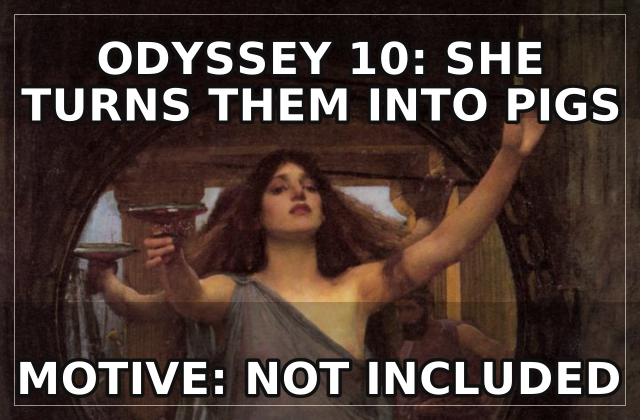
The endnotes document my thoughts as I wrote this.
Circe is (arguably) only infamous for one thing: she turns Odysseus’ men into pigs. If you’ve had some degree of interaction with the Odyssey, you may remember her as a fun, slightly grotesque halftime show between the Cyclops and trip to the Underworld. If you saw Nolan’s The Odyssey this summer, you probably remember her as the witchy woman in the scene where you covered your eyes.
A few nights ago, I had a dream (maybe a nightmare?). I was a chair in Circe’s hut (it looked exactly like the movie, by the way—truly eerily realistic) and could only watch as Eurylochus et al. were manipulated1 into pigs. Somewhere in my head, a middle school anti-bullying speaker was telling me to say something (“don’t be a passive bystander, kids!”), but I was a chair, so I couldn’t really. So recently, I’ve been wrestling with a question about, yes you guessed it, Circe: why does she do “it”?
Go back and read Book 10 looking for a reason and you’ll find there really isn’t one. Homer tells you what Circe does, sure (and in a lot of detail), and then moves on without telling you why she possibly was so driven to turn these men into swines. For about 2,700 years, every retelling has somewhat filled that blank for her.
The OG “text” (although this is also not right because the “text” is just multiple written accounts of multiple storytellers’ versions of the story strewn together) details Odysseus splitting his crew in half, and one group, led by noble Eurylochus, going to investigate a house in a clearing (the start of my nightmare). The first thing they see is wolves and mountain lions, which don’t attack. Instead, the animals come up wagging their tails, and Homer compares them to dogs greeting their master when he comes home from dinner, because he always brings them scraps (10.216-17).
That is a very cozy image (isn’t it)!... for a scene that’s about to go horribly wrong. Homer’s version says Circe drugged the animals; it never says they used to be men. Almost every modern version assumes they’re former sailors (like Odysseus and his men), and in Nolan’s film the animals on the island clearly used to be men (like when Odysseus shot a stag and upon looking at the carcass it was a man)2. They might very well just have been lions or wolves.
Circe is inside, singing at her loom, and she invites the men in. Everyone goes except Eurylochus, who suspects a trap and waits outside. He’s the cautious guy here, but then again two books later he’s also the guy who talks the starving crew into eating the forbidden cattle of Titan Sun-god Helios (also, by the way, Circe’s dad), which gets everyone except Odysseus killed. So it’s pretty ironic: the one man in that group smart enough to skip Circe’s dinner is also the man who orders the worst meal in the entire epic.
Inside, Circe serves cheese, barley, honey, and wine, and mixes in what Homer calls φάρμακα λύγρ᾽ (pharmaka lugra, wicked drugs). He tells us exactly what the drugs are for: so the men will completely forget their homeland (10.236). Note the whole Odyssey is a νόστος (homecoming story), and nearly every danger in it is a version of forgetting home. The Lotus-Eaters make you forget. The Sirens make you stay. Calypso offers you immortality if you’ll stop wanting Ithaca. Circe’s drug therefore lies in the same category. One could propose Homer registers Circe as a homesickness problem and not a morality problem. By extension, the danger is that they won’t want to leave.
Then she gives them a little tap of her wand, and then:
οἱ δὲ συῶν μὲν ἔχον κεφαλὰς φωνήν τε τρίχας τε καὶ δέμας, αὐτὰρ νοῦς ἦν ἔμπεδος, ὡς τὸ πάρος περ.
(10.239–40)
Their minds stay the same: the men are completely aware, completely themselves inside, and completely unable to say so. Homer’s version does not contain men who’ve been exposed as pigs (indicating that the pigs are their “true” form), because in this the pigs are the disguise they’re trapped into. The next detail is that they’re crying in the pen—conscious and aware.
So far there’s no motive or reason behind this.
Then Hermes shows up to help Odysseus (psa: this is cut out in the movie, like many other parts…), and he doesn’t even warn Odysseus about Circe, the woman who’s turned half his crew into pigs. Instead, Hermes gives Odysseus a magic plant called moly, black at the root with a flower white as milk, which gods can dig up easily and mortals can’t (10.302-306). Side note: in 1983, two neurologists published a paper arguing that moly was the snowdrop flower (which counteracts jimsonweed poisoning—they argued that the mixture Circe gave the men likely had jimsonweed, which mainly causes hallucinations/confusion/memory loss). The memory loss is actually a pretty neat point (not literally), because it matches Homer saying the drug makes them forget home.
Then Hermes gets to what actually worries him. Circe will try her wand, and Odysseus should draw his sword as if to kill her. She’ll get scared and invite him to bed. He shouldn’t say no, but he has to make her swear a great oath first. Otherwise, once he’s undressed, she might make him κακὸν καὶ ἀνήνορα (kakon kai anēnora, 10.301). Anēnōr is built from a-, “not,” and anēr, “man.” It means unmanned; that’s the real threat, apparently, at least to Hermes. The crew turning into pigs is a problem, but the thing an Olympian personally comes down to prevent is the hero being unmanned in bed. Hermes doesn’t tell Odysseus to punish/shame her. And so Odysseus draws his sword, Circe falls at his knees, she swears the oath, and they go to bed. Then she turns the crew back into men, and Homer says they come out younger, taller, and much more handsome than they were before (10.395-96). Even Circe is moved when she sees them crying with relief. Somehow the most famous punishment in Greek mythology ends with everyone looking better than when they arrived. Does this remind you of a spa retreat-esque interlude?
Then Odysseus stays for a year. Homer doesn’t make a big deal of it. At the end of the year, the crew, men who were recently pigs, have to take their captain aside and remind him that he has a wife and kid at home and should probably start heading back. Before he leaves, Circe gives him the most detailed and useful travel advice anyone gives him in the entire poem: how to reach the underworld, how to get past the Sirens, how to choose between Scylla and Charybdis, and why under no circumstances to eat the Sun’s cattle (Eurylochus, please note…).
So in Homer, Circe is something like a powerful neighbor. You “handle” her by negotiating. Once you have, she’s a remarkably good host. And so yes, the book ends without her explanation on the motive behind turning the men into pigs.
The ancient Romans prodded this. Horace, in a letter to a young friend about what Homer can teach us, turns Book 10 into a lesson about self-control. If Odysseus had drunk from her cup with his crew, he would have lived sub domina meretrice (under a mistress who is a whore/prostitute) turpis et excors (disgraced and brainless), as a canis immundus vel amica luto sus (an unclean dog or a sow that’s friendly with the mud) (Epistles 1.2.25–26).
Amica is also the normal Latin word for “girlfriend.” Domina is the word Roman love poets used for the woman who controls her lover’s life. Horace is supposedly writing about moral philosophy, and he continuously uses dating vocabulary (think “huzz” or “situationship”). In Horace’s letter, Circe is essentially likened to a bad girlfriend, and even the pig has a relationship with the mud.
More importantly, Horace gives the pigs a meaning. Now, they symbolize what greedy men really are, and Circe is “to blame” for bringing it out.
Then the feminist retellings arrive: 1999, Carol Ann Duffy publishes a satirical poem called “Circe” in which Circe instructs her nymphs a recipe for pork, with every ingredient doubling as a body part of the men she’s cooked. She tells them to season it with mace, the spice and the pepper spray. In 2018, Madeline Miller’s novel Circe let her tell the whole story herself. Miller’s Circe begins by hosting sailors exactly as she’s supposed to (Zeus’ law type), until one crew realizes she lives alone and their captain sexually assaults her. After that, every crew that lands becomes pigs regardless of whether they intended on harming her or not.
I personally really enjoyed reading Miller’s book, but I also think it’s worth noticing what Miller does with the blank Homer left: it fills it with an injury. Miller’s Circe gets to turn men into pigs because she was hurt. It makes her earn an action Homer simply gave her.
Even her craft and power is learned, too. Miller’s Circe masters the use of herbs through years of grinding them and failing, while Homer’s Circe has a wand/staff. The modern Circe seems kinder, sadder, and harder-working.
Then there’s Nolan. Samantha Morton plays Circe as a grimy witch in a collapsing hut (again, this was the start to my nightmare), with a cauldron and a raven in a cage. She feeds the crew a hearty stew, and when they start choking, she grabs their faces and works them into snouts by hand, like clay… (fun fact: the haunting humming during that scene wasn’t scripted). She later explains herself:
[Circe] I didn’t turn your men into anything! This is who they are. Look at them –
[Circe] Base. Disgusting, primal urges you value in battle… they’ve raped and pillaged across the world for you – you think that’s against their nature? You think they only did those things because you ordered them to? A true commander thinks his men’s savagery is actually discipline. You don’t seem that deluded. But you sent them to me, here, on my own. A gang of filthy soldiers with empty bellies and hot blood. You thought they’d respect me and my home? Look at them. Know your own men.
[Odysseus] Did they hurt you?
[Circe] They would’ve.
[Odysseus] They just want to go home. Let them.
[Circe] Let her go. Come back. Back into your disguises…
Note that when she changes them back, she calls their human bodies their “disguises.”
That line is Horace! It’s Horace with the roles reversed. The morals are flipped (Nolan doesn’t condemn or criticize Circe as hard as Horace for her actions), but the idea underneath hasn’t moved: the transformation is a revelation.
And Homer had already answered it. Their minds stayed fixed, just as before. In the original, man is the real form and pig is the disguise. Nolan’s Circe has it exactly backwards: pig is the real form and man is the disguise.
(Adding onto the endnotes: Nolan’s movie and what Circe says contradict each other. Circe says she’s only showing the men who they are, but we watch her shape their faces with her hands like a potter. That, obviously, isn’t revealing a “true” form because she’s the one actively choosing it for the men. Then there’s the stag: when Odysseus shoots it, the body turns back into a man. If the pig (or the deer) were the true self, death would probably leave it there? Instead, death undoes the disguise, which affirms Homer’s version.)
But to be fair, one ancient writer does somewhat agree with Nolan’s Circe. Plutarch wrote a short dialogue in which Odysseus asks Circe to turn some Greeks still living as animals back into men. She says fine, but he has to ask them first. The pig he asks, named Gryllus, (“Grunter”) says no. He then gives a whole speech about why pigs are better than men: braver (because they don’t need anyone to praise their courage); more sensible about food and sex; and not obsessed with gold/fancy clothes. Odysseus never replies; the text breaks off. So the theory that men are the real pigs (or even sub-pigs) does go back to ancient Greece. It was just first proposed by a pig, and he won by default?
What I keep coming back to is that Homer is the only one who lets Circe go unexplained. Horace made her into a lesson about morals and gluttony; Miller prescribed her a wound; Nolan gives her a justified motive. Each of them, in their own way, decide that a woman with that much power must have a reason for using it, and that the reason we find should tell us something about men.
I understand this impulse because I had it too. The first time I read Book 10, I also went looking around for a motive the same way you feel around for a light switch in a dark room. We’re used to stories where power and climatic actions come with origin stories attached: the villain was wronged (therefore prompting them to make such drastic actions/entering the villain era), the witch was betrayed, the monster was misunderstood. A backstory makes power feel “fair.”
Homer’s Circe is frightening, then, to these standards; she isn’t a cautionary tale, a victim, or any of those common tropes. She’s a goddess on an island (Queen of Aeaea), and that seems enough.
Or maybe some ancient bard gave her a motive once, in a version performed aloud and never written down, and it disappeared the way most of the ancient world did.
Endnotes
- Then is Circe deciding what their “true” form is? it’s not like the moly (in Miller’s book) just reveals what they truly are because movie suggests that Circe is responsible and has authority in SHAPING them ↩︎
- This also touches on the point of how the animals, then, are not the “true” self because after death they revert back to their “true” form—man. So that’s an aspect Nolan “argues” by having this scene? ↩︎