Thinking Outside Pandora’s Box
“A jar is something you’re supposed to open; that’s the whole point of a jar.”
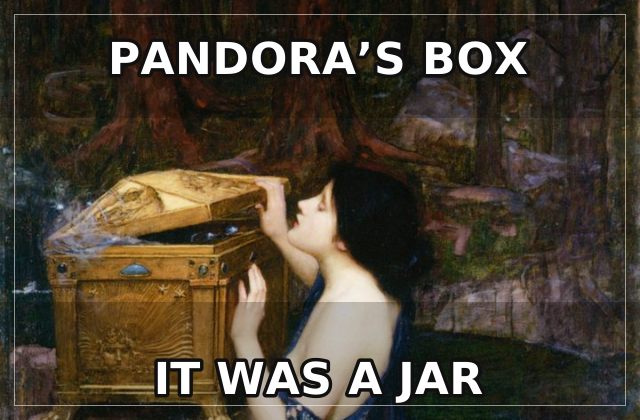
So in my unboxing piece a few months ago, Pandora’s PR box came with a little note on top that said DO NOT OPEN. I made that up… I’m sorry. But hey, it turns out, basically everyone else did too! For about five hundred years. Eek.
About Pandora’s box: there’s actually no box. In Hesiod’s Works and Days, the oldest version of the story we have (dated to back around 700 BC), the “container” is a πίθος (pithos), a man-sized ceramic storage jar holding liquids like olive oil and wine, as well as dry goods like grain. The “box” mistranslation arrives in the early 16th century, when humanist Erasmus retold the story in his Adagia (an enormous and very popular collection of his annotations of ancient Greek and Roman proverbs/adages, hence the name), and wrote in it that Pandora arrived with a pyxis, a small lidded box, instead. Art historians Dora and Erwin Panofsky (fun fact: they’re known as Pan-Dora), who wrote an entire book tracing this in 1956 suspected Erasmus had blended Pandora with Psyche (from the myth Eros and Psyche), who in Apuleius’ The Golden Ass carries a little pyxis back from the underworld and opens it out of curiosity. Erasmus’s version popularized the tale (which also contained phrases like “blind leading the blind”), and with it this conceptual conflation: “Pandora’s box.”
I realize as I write this that the above sounds like a jeopardy question or a trivia kinda thing you say at dinner to be annoying. BUT… the box isn’t a harmless mistake I swear. A box and a jar are fundamentally different kinds of objects, and so swapping one for the other would change what, if anything, Pandora did wrong. A box is small/private, something you shouldn’t strongly feel inclined to open. A jar is something you’re supposed to open; that’s the whole point of a jar. Change the container and you change the register of Pandora’s fault.
Starting with what Hesiod actually writes: Zeus is furious with Prometheus for stealing fire, so he gives mankind a “gift.” Hephaestus molds a woman out of earth and water. Athena teaches her weaving. Aphrodite pours charm and aching desire over her. Hermes gives her “a shameless mind and a deceitful nature” (WD 67). Every Olympian contributes something, which is why she’s named Pandora (WD 80–82), usually taken to mean “all-endowed,” the woman each who “dwelt on Olympus” gave a gift to.
Side note: the name works just as well as “all-giving.” Pandora seems to have also been a title of the Earth (Gaia you’ve got competition), the one who gives everything. An Athenian cup in the British Museum shows Athena and Hephaestus dressing a woman labeled Anesidora, “she who sends up gifts,” which is exactly what the ground does. So before her name may have meant “the one who gives.”
Prometheus had warned his brother Epimetheus never to accept a gift from Zeus. Epimetheus accepts anyway, and Hesiod notes that he only understood why once he had the evil in his house (“But he took the gift, and afterwards, when the evil thing was already his, he understood,” WD 89). Epimetheus’ name means “after-thought,” how fitting.
“But the woman took off the great lid of the jar with her hands and scattered all these” (WD 94–95).
That’s it. Hesiod doesn’t say what she thought was in it. Pandora does the grave act and the poem keeps moving. The rule forbidding her from opening it came later. The most famous version is Nathaniel Hawthorne’s 1852 children’s book A Wonder-Book, where Pandora is a nosy little girl, the box is delivered by a messenger, and she’s been told not to touch it. Honestly by that point she basically was merged again with another figure, this time with Eve: a woman, a rule, a forbidden object, curiosity, downfall of mankind. That becomes a whole different story centered around HER disobedience.
Works and Days is a farming manual in verse. It’s addressed to Hesiod’s brother Perses, who apparently took more than his share of their inheritance, wasted it, and is now being lectured for 800 lines about plowing on time. Before Pandora, Hesiod says, people lived “free from ills and hard toil and heavy sickness” (WD 90–92). Earlier in the poem he says: “For the gods keep hidden from men the means of life. Else you would easily do work enough in a day to supply you for a full year even without working” (WD 42–44). After opening the jar, man has to work constantly.
Hesiod also has his own opinions about jars. About 270 lines later, in the middle of advice about wine, he says: “Take your fill when the cask is first opened and when it is nearly spent, but midways be sparing: it is poor saving when you come to the lees” (WD 368–69). For Hesiod, a jar is the future, carefully rationed. Pandora’s jar is the evil twin of that: you open it expecting next winter’s grain, and you get next winter’s illnesses.
After, “Only Hope remained there in an unbreakable home within under the rim of the great jar, and did not fly out at the door”(WD 96–97).
First, hope is not at the bottom of the jar, the way every inspirational poster says. Hesiod puts her “under the rim” of the jar, right at the top as if she was about to leave and the lid came down on her. Second, he calls the jar her “unbreakable home,” which is an odd thing to call a clay pot, and it makes Hope sound like a prisoner.
And so the big questions: if the jar was full of evils, is hope one of them? And if she stayed in the jar, does that mean we have her, or that we don’t?
The ancient Greek poet Theognis wrote in his Elegies that “Hope is the one good God yet left among mankind; the rest have forsaken us and gone to Olympus” (Theognis 1135–38); essentially all the others (Trust, Self-Control, Graces) packed up and moved to Olympus. A fable by Babrius has a version where Zeus’s jar is full of good things, a man opens it out of curiosity, all the goods fly back up to the gods, and Hope is the only good thing left behind (Babrius 58).
Hesiod uses the word ἐλπίς (elpis, Hope) again later in the same poem, and he does not mean it nicely. In the section on winter, he warns that “the idle man who waits on empty hope, lacking a livelihood, lays to heart mischief-making,” and that hope is not a good companion for a man in need (WD 498–500).
So maybe that’s one question answered. The evils that got out are the ones you can’t control: sickness, hard work, a sea and land full of trouble. The one that stayed in is (the evil?) what you carry around in your own head: the Hope that you won’t have to deal with any of that. Pandora releases the reason you have to work and keeps, sealed under the lid, the temptation not to. Whether Hope stayed in the jar to stay with us or to stay away from us, Hesiod’s farm-manager answer is the same: you shouldn’t be living off her.
In Human, All Too Human (1878), Nietzsche argued that hope is actually the worst of the evils, because it drags out our suffering; Zeus left it with us on purpose so we’d keep going and keep being tormented. Perhaps this may be too operatic for Hesiod, who’s just saying that hope is not going to do the labor for you?
So the mistranslation into “box” altered the register of opening the container and added a rule, so Pandora could break it. It turned a story about the toils of living into a story about a woman who touched something she shouldn’t have, which is a far more familiar trope and also a far easier one to blame on someone. Hesiod was already quite hard on her: in the Theogony he famously calls her a καλὸν κακόν (kalon kakon), a “beautiful evil,” and blames her for the entire “race of women.”
You fill a jar precisely so that someone, someday, will open it. Pandora did exactly what jars are for. What came out was the world we’ve been working in ever since, and the one thing she kept back was the hope that we wouldn’t have to. And if hope indeed was one of the evils, why is it the only one we’ve ever called a gift?