Notes On Epic: what I’ve been working on in my Epic Traditions elective (#3, Week 4)
“Old gesture, new hero, new story.”
“‘The Voyage of the Sable Venus’ is an epic written in one line.”
Lewis, Broken, Defaced, Unseen: The Hidden Black Female Figures of Western Art
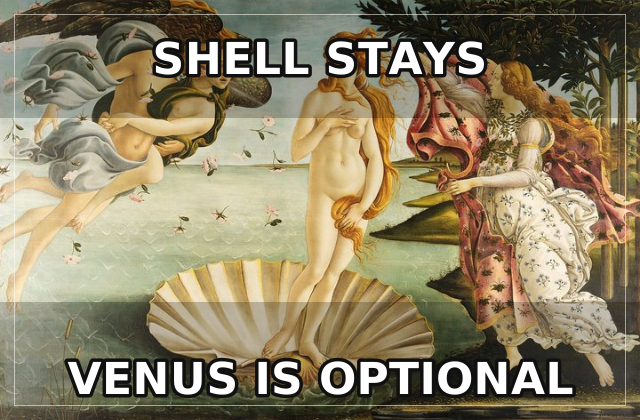
ABSTRACT: Epic is still defined by how it moves its audience, so art can be epic too. A modern epic is tied to prior epics by its gestures, not its figures; and it becomes its own by reclaiming the ties that were once forced, and choosing what fills those gestures (mentioned earlier). With Botticelli, e.g. shell stays, Venus is optional.
August 7, 1908: Near the Austrian village of Willendorf, a four-inch limestone woman is pulled out of the dirt: ample breasts, wide hips, a head of concentric circles (erasing the face). She is over 25,000 years old; soon, she is titled Venus (never mind that Venus wouldn’t be “born” for roughly another twenty millennia). I’ll circle back to this naming. I’ve noticed one criterion for epic has held so far: epic is defined by what it does to its audience, by its ability to leave us “mov’d…[and] satisfy’d” (Voltaire). And if that’s the “test,” then an engraving/oil painting/list of museum titles can all pass it just as well as a sung hexameter. Essentially: the medium has changed, but the purpose has not. Yet, precisely because the medium has changed (Rosales does not paint in dactylic hexameter), the Greco-Roman rubric of my last two responses simply cannot be constantly built off of. I set that rubric aside and present a “new” response.
Q1: How tied must modern epic be to prior epics?
Some ties are unavoidable: an audience can only recognize epic through something it has seen before. In Response #2, I argued that Lucretius “performs the gesture of invocation, because the gesture is what signals epic.” Now, I extend further to say that gestures are all that need to survive for modern epic to be tied to prior epics. This means the “figure” / content inside is up for grabs. Example: Lewis’ Voyage of the Sable Venus, a poem built entirely from catalogue entries and titles of Western artworks containing black female figures; it contains a section headed “Invocation.” No Muse answers. Lewis instead opens with “Untitled / Anonymous / Clay.” The Muse, it seems, has been replaced by the muse-um (how fitting! Since “museum” comes from Greek: μουσεῖον, “seat of the Muses”). There is more irony, too. Hesiod’s Muses are daughters of Mnemosyne (Memory), and their “task” is to grant kleos—lasting glory that keeps the “hero’s” name alive. Lewis takes up this same task, except for a collective of thousands of forgotten women. But her own “rules” forbid her from changing a single title, so she can only remember them in the way of those who carved, sold, and catalogued them (“Statuette of a Black Slave Girl / Right Half of Body and Head Missing”). Homer’s glory preserves hero; Lewis’ preserves the injury (and with it the guilt of every person who committed the act of labelling). I want to highlight: Lewis chose to plant an ancient epic gesture in her poem (not required) so that we could recognize the backdrop of epic. That is a chosen tie: artists reaching back to tradition on purpose, and deciding (for the purposes of their art) what is borrowed and changed.
“Let your eye be a candle in a chamber, / your gaze a knife”
Paul Celan, Rita Dove, The Venus of Willendorf
Not every tie is chosen. Some are forced onto a work by those who look at it; in these cases, the gaze of the viewers becomes the transforming force that the mighty gods once were in Ovid. So back to Willendorf: her carvers never heard of Venus. The name was stamped onto her, just as it was onto Sarah Baartman (displayed in London and Paris as the “Hottentot Venus”); they had previous identities / names—erased by those who labelled them. Here the Greco-Roman tie is no longer a gesture the “artist” performs, because it’s now a “brand-ing.” Extension: once branded, the body begins to change. In Dove, a black student is so relentlessly compared to the village’s Venus of Willendorf that “she could feel her own breasts / settle and the ripening / predicament of hip and thigh” (Dove, 26). In Lewis’ Voyage of the Sable Venus, women are metamorphosed into spoon handles and table legs. In Alexander’s The Venus Hottentot, Cuvier reduces Baartman to “genitalia / … float[ing] inside a labeled / pickling jar” (Alexander). Ovid’s Metamorphoses: “bodies changed into new forms.” This week, the bodies are still changing, but no god is responsible.
Q2: How can modern epics become their own?
By taking hold of the tie: choosing it where it was once forced, and deciding what fills the “gesture.” Alexander’s Baartman begins this reversal. Laying on Cuvier’s table, she imagines seizing “his knives” and sealing his heart in a jar instead (the gaze, briefly, turned back on the gaze-r). Rosales “completes” it. Her Birth of Oshún borrows Botticelli’s shell, wind-figures, attendant (framing) but places at its center a completely different goddess, independent of the label Venus. This independence is significant, because the label is how the tie was forced in the first place. Rosales points out (interview) that no one calls art by white artists “white art,” yet “black art” is applied the moment a black artist (or subject) holds center stage. The Venus label works similarly: “Hottentot Venus,” “Sable Venus,” “Venus of Willendorf.” Each modifier marks a variant, an “other,” set beneath the pedestal of an unmarked, “original” Venus. Rosales’ Oshún needs no adjective preceding her because she was never a “Venus” at all. In a sense, I see Oshún taking on Venus as a formidable and equal-footed “competitor” rather than a subordinate. The modern epics we’ve seen also change more than who stands at the center, and where grandeur is found. E.g. grandeur moves from one hero/figure to a crowd (Lewis’ ship of thousands of “Untitled”), and epic’s urge to say everything also gives way to the power of what is withheld: Alexander’s Baartman, her body made public, keeps “other parts private.”
Lewis’ essay: a nostos with every gesture intact (a ship, ports of call, homecoming to New York). But at the pier, the hero learns she was never the rescuer; she was one of the women being carried home. Old gesture, new hero, new story. My rubric for modern epic, then: it still moves its audience, it makes a gesture we recognize as epic, it chooses (or reclaims) its tie to tradition, it engages with the world it was made in, and it finds grandeur in the many and in what goes unsaid.