Notes On Epic: what I’ve been working on in my Epic Traditions elective (#1, Week 1)
“So whether we laugh at gods caught cheating or weep at the fall of Troy, the verdict is all the same: epic.”
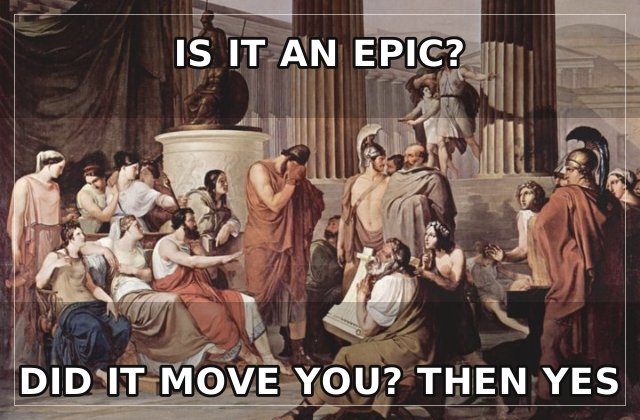
“We have in every Art more Rules than Examples, for Men are more fond of teaching, than able to perform”
Voltaire’s An Essay on Epic Poetry, 1727
ABSTRACT: an epic is defined by what it intends to and ends up doing to its audience, not by what it contains or necessarily how it contains it. Each tradition/culture can have its own unique features and still produce an epic. Such features in Greco-Roman epic include the invocation to the Muses, metapoetic passages, and involvement of some “grand” figure.
The word “epic” dates back to ancient Greek noun ἔπος, meaning “word” or “story.” The general conception (or might I say mis-conception) I previously held surrounding epics was as follows: they must be immense tales (both in size and grandeur) detailing the arduous toils / perilous journeys of some glorious, charming, handsome, epitome-of-mankind hero (or immortal)—and they are written in some poetic meter, and performed in some oral way. I therefore plead guilty to what Voltaire calls out: “shut[ting] our Eyes to all the Beauties that [Nature’s] Hands pour around us, in order to look back fixedly on her former Productions.” I had crowned Homer’s Iliad and Odyssey as THE divine epic “texts” (psa: not texts and certainly not as in fixed texts) and shunned most others.
Voltaire says “A Suit of Cloaths in itself, is the covering of the Body, that is all that is essential to it.” Essentially, fashions change, but every suit has the same purpose; then, the purpose of the epic is what truly “matters.” Voltaire mentions that epic poetry has “some great Action…[that] should be great, to strike us with Awe…because we delight in being mov’d…that our Minds may be wholly satisfy’d,” but that this Action is not confined geographically, to singular characters, or to social standings (“let them be Kings, or Generals, or neither”). As long as it achieves its purpose of inducing the above effects (“mov’d…satisfy’d”) and contains that “some great Action…the Poem will equally deserve the Name of Epick.” Still, the “great Action” is just the vehicle to strike its audience with awe (the purpose). And since epic crosses borders and centuries, it naturally can’t be held to rigid rules on form, artistry, and structure.
“22 [It was the Muses] who… breathed into me a voice [audē], 32 a godlike one, so that I may make glory [kleos] for things that will be and things that have been.”
Hesiod’s Theogony, 22-33.
Segue specifically into ancient Greco-Roman epics, which share a few common traits. The first is the reference to / direct invocation to the Muses for guidance, inspiration, and knowledge (Hesiod: for those “honored [timân] by these daughters of great Zeus [= the Muses] 82 … they pour sweet dew upon his tongue, 84 and from his mouth flow sweet words”). The presence of the Muses is a hallmark of Greco-Roman epics.
The second trait branches off of the first: metapoetry. These poems cannot stop singing about singing—this can present in the form of invoking the Muses, referencing other singers / their songs, the general nature in which Muses inspire and bless poetry, etc. In the Iliad, Nestor is “the lucid speaker of Pylos, from whose lips the streams of words ran sweeter than honey;” which is literally the metapoetic act of someone who is A) blessed by the Muses (like how Theogony 22-33 describes) and B) using sweet words to “hold the plot together”—metapoetic glue, if you will. Perhaps this trait applied in a modern sense looks like: a rap with lyrics about rapping / rap-culture / name-dropping other rappers / bragging about their bars.
The third trait is a “grand” figure(s), though not necessarily a grand deed. Hesiod’s Theogony, for example, is a whole aetia of the Greek cosmos instead of a hero’s tale. And in Homer’s Odyssey, Demodokos sings of Ares and Aphrodite ensnared in Hephaestus’ golden net while the other gods flock around, with Hermes admitting he’d happily take thrice the “number of endless fastenings” to lie beside Aphrodite. As I read this, I thought: wow, this is kinda gossipy. Yet the same Demodokos also sings of the Trojan Horse, bringing Odysseus to “pitiful tears.” Laughing or weeping, his audience is “mov’d…[and] satisfy’d.” And in staging its own audiences’ reactions, the Odyssey models the very response it seeks from us, so Demodokos’ songs, though embedded within an epic (metapoetic), reveal what the epic itself sets out to do. Epics may not need “epic,” heroic acts, only “grand” figures—and Olympians tangled in a net are still Olympians.
So whether we laugh at gods caught cheating or weep at the fall of Troy, the verdict is all the same: epic.