Notes On Epic: what I’ve been working on in my Epic Traditions elective (#2, Week 2)
“It still invokes the Muses, but now it also provokes us.”
“I want to speak about bodies changed into new forms. You, gods, since you are the ones who alter these…”
Ovid’s Metamorphoses 1.1-2
ABSTRACT: Roman epic keeps the purpose (moving its audience) which I previously said defined epic, but by appropriating and experimenting with Greek epic traditions it expands that purpose to provoking thought. My rubric therefore keeps my previous three Greek criteria (invocation, metapoetry, “grand-ness”) with two redefined, and proposes a fourth: a conscious dialogue with tradition and with the poet’s own time. The verdict of epic has changed as we’ve migrated to a new location and progressed to a new era this week. Or, should I say, metamorphosed.
241 BCE. Rome has just conquered Sicily, “a renowned cockpit for intermittent warfare between Carthaginians and Greeks for some two hundred and fifty years” (Feeney, 122). The Romans are thrown into the spotlight, both metaphorically and literally, as the new imperial power of the Mediterranean. The theatrical stage becomes another arena in which to flaunt Roman prowess; Roman epic naturally follows. Previously, the Greeks had made epic, with all its grandeur and monumentality, arguably the most esteemed form in the region. So the Romans “appropriate” (term used throughout the readings) because it is now up to them to solidify their legacy; they propel their own language/culture forward, riding the respected wave of Greek epic.
First key difference: space epic occupies. In Greece, epic served largely (though not entirely) as entertainment and a display of tradition/culture. In Rome, it turns graver and more self-conscious, grappling with morality, demythologizing, challenging comfortable archetypes, etc. Also, the Greek poet presents himself as a vessel for the Muse, and his song bends towards its listeners to make them laugh, cry, and feel. The Roman poet steps out from behind the Muse and implicates the reader in their grand scheme. So we are still moved, but now we are moved somewhere. Part of this may stem from a shift in format: Roman epic is written to be read, not just performed, and a reader can pause/reread/reflect.
Roman epic is in constant, exploitative dialogue with Greek epic, but that dialogue is not purely parasitic, because the two traditions challenge, toy with, and develop off each other. Take the Muses. The invocation survives, but its intent shifts. To exemplify, Lucretius “seeks to appropriate the grandeur and glamour of Homeric narrative for his epic of nature, while rigorously excluding the conventional divine machinery” (Gale, 444). He opens with a hymn to Venus (instead of the Muses), mother of Aeneas and thereby of the Romans. An Epicurean who denies the supernatural still performs the gesture of invocation, because the gesture is what signals epic; and he aims it at Rome’s own “divine” ancestor.
Second: the metapoetic aspect holds, as shown in Ovid handing almost the whole of Book 10 to Orpheus (a singer singing within the song), or Lucretius’ comparison of his work to “the honey which doctors smear…medicine” (Gale, 445).
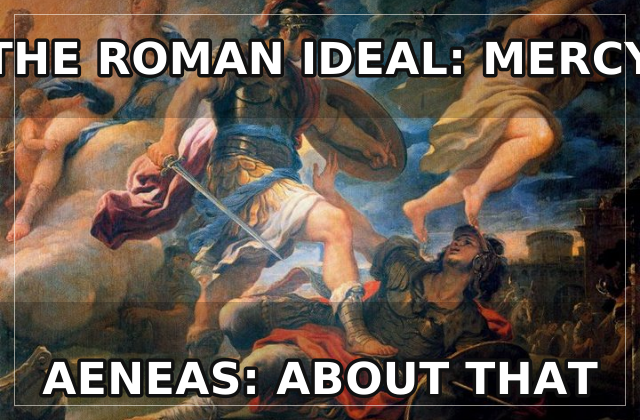
The third criterion of having a “grand” figure or deed is less stable. At first glance, Virgil and Lucretius satisfy it: Aeneid → founding of Rome, De rerum natura → principles of universe. And Ovid rejects it: he “emphasiz[es] the marginal character and marginal event, and the erotic and the pathetic over the martial and heroic” (Newlands, 477). However, Lucretius’ heroes, Epicurus and natura, are themselves “unconventional heroes, from the perspective of Roman Republican ideology as well as epic tradition” (Gale, 448). Virgil also reimagines heroism itself by adding “an ethical dimension to heroic action” (Putnam, 455) in which the victor essentially displays mercy. It is “a more social form of heroism than Homer’s” (Putnam, 455) where triumph rests on “a highly spiritual decision” rather than “some glorious deed of valor” (Putnam, 464). Yet Aeneas fails this very test by killing Turnus. So the grand figure remains, but he is tousled, questioned, and de-romanticized. Greek epics also tended to reward a heroic deed with lasting kleos. In Roman epics, fragility and mortality tend to follow glory, and Virgil for one “has no intention of giving us the pleasure of a happy rounding out of Roman history” (Putnam, 460).
Proposing the fourth: Roman epic reflects the world it was written in more than Greek epic does. The clearest example is how Virgil wrote the Aeneid, under Augustus, after decades of civil war. His ending’s circularity reads as “his pessimistic way of candidly depicting the continuity not only of Aeneas’ career but of Roman, and human, history as it evolves” (Putnam, 465). We should be careful not to read these poems as coded manifestos, but they do function as cautionary tales for a Rome still learning what its power would cost and hold. Greek epic looked back to a heroic age; Roman epic looks at its own.
With works like the Metamorphoses, where “‘scarcely an area of epic technique is left unscathed by Ovid’s powerful experiments’” (Newlands, 481), Roman epic can look deliberately “contrarian” from every angle. But by reversing Greek conventions, it only highlights them further, since you cannot flip a convention without first putting it on display. Roman epic still accomplishes the purpose of moving its audience, but that purpose now expands to include provoking thought. It still invokes the Muses, but now it also provokes us.